

Drive across Daly City and the roof environment can change before the architecture does.
Closer to the Pacific, marine air and fog can keep surfaces cooler and damp longer. Travel east, and conditions become less fog-heavy. Add hillside streets, tightly packed homes, and neighborhoods built during different periods, and the idea of one standard “Daly City roof” quickly falls apart.
San Francisco Roofing Contractors looks at those differences before drawing conclusions about what a roof needs. The block, exposure, roof shape, surrounding homes, and where moisture or wear first appears all provide useful context.
Daly City itself recognizes distinct neighborhoods on either side of I-280, including Westlake, St. Francis Heights, Serramonte, Original Daly City, Hillside, Crocker, Southern Hills, and Bayshore.
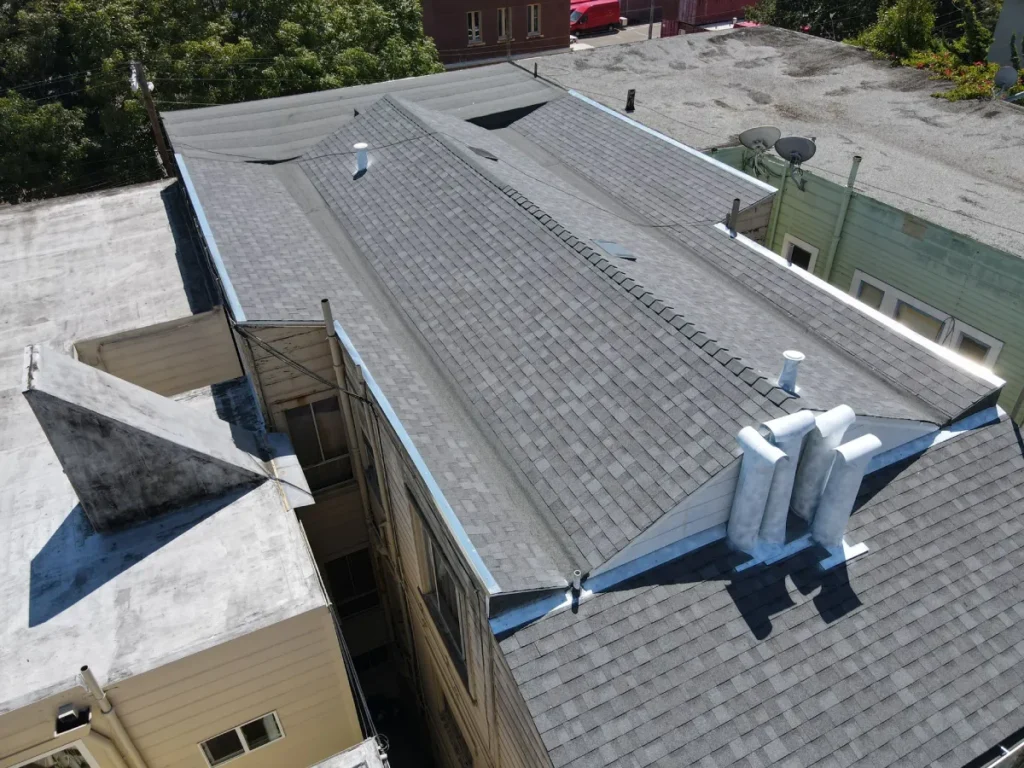
Westlake, St. Francis Heights, and Serramonte sit on the western side of Daly City, closer to the Pacific influence. The city notes that this side experiences more fog than neighborhoods farther east, where the marine layer is less persistent.
That does not automatically mean a roof has a moisture problem. It does mean drying patterns deserve attention.
Low areas, flashing transitions, gutters, penetrations, and shaded sections may behave differently when surfaces remain damp longer. On older roofs, small drainage or sealing issues can become easier to notice when the same areas repeatedly hold moisture.
Westlake brings another layer of local character. Much of the neighborhood dates to the postwar development period, with many detached, split-level homes built during the 1950s. As those homes age, roofing decisions often need to consider earlier repairs, original construction details, and changes made over several decades.
Cross toward Original Daly City, Hillside, Crocker, Southern Hills, and Bayshore, and the setting changes.
Fog becomes less dominant, but topography, building spacing, roof access, and surrounding structures still affect what happens overhead. In hillside areas, wind exposure and fast-moving runoff can put greater attention on edges, transitions, and drainage paths. In denser blocks, neighboring buildings can make certain roof areas difficult to see or reach from the street.
That is why the visible symptom is only the beginning.
A ceiling stain may trace back to flashing several feet away. A recurring damp area may have more to do with drainage than with the roof surface itself. Details decide durability, especially where elevation and surrounding construction influence how water moves.

If one area of your roof stays damp, a drain repeatedly backs up, flashing looks different than it used to, or a ceiling mark appears after certain weather, the location of the property can help narrow the possibilities.
Tell us whether you are in Westlake, Serramonte, Hillside, Bayshore, Original Daly City, or another Daly City neighborhood, and tell us what has changed.
We will start with those clues instead of forcing the roof into a generic checklist.
 Trustindex verifies that the original source of the review is Google.

 Trustindex verifies that the original source of the review is Google.
 Trustindex verifies that the original source of the review is Google.
 Trustindex verifies that the original source of the review is Google.

We use cookies to improve your experience and to record and monitor communications on our site. By using our site, you consent to our use of cookies and agree to our Privacy Policy and Term of Use.
Manage your cookie preferences below:
Essential cookies enable basic functions and are necessary for the proper function of the website.
These cookies are needed for adding comments on this website.
Statistics cookies collect information anonymously. This information helps us understand how visitors use our website.
Google Analytics is a powerful tool that tracks and analyzes website traffic for informed marketing decisions.
Service URL: policies.google.com (opens in a new window)
Marketing cookies are used to follow visitors to websites. The intention is to show ads that are relevant and engaging to the individual user.
Google Maps is a web mapping service providing satellite imagery, real-time navigation, and location-based information.
Service URL: policies.google.com (opens in a new window)
You can find more information in our Terms of Service and Privacy Policy.