
On a SoMA rooftop, the first leak is rarely in the open membrane. More often, it sits beside a condensate line someone rerouted across an HVAC curb two tenants ago.
A commercial roof inspection checklist is a structured walk-through of a low-slope roof’s membrane, seams, flashing, drains, penetrations, and rooftop equipment. Each finding is recorded so the next visit can be compared against the last one.
That matters because commercial roofs rarely fail all at once. They fail at details, slowly, while the offices or shops below stay busy and unaware.
San Francisco changes the list. Fog keeps membranes damp long after rain clears. Salt air near the bay corrodes edge metal and fasteners. And downtown rooftops carry more equipment, and more penetrations, than a typical suburban warehouse.
What Parts of a Commercial Roof Get Inspected?
A low-slope roof works as one system, but it fails by zone. Here is where attention goes, and what tends to turn up in this city.
| Roof Zone | What Gets Checked | What Often Turns Up in San Francisco |
| Drainage | Drains, strainers, scuppers, overflow outlets | Debris from street trees and wind-blown litter; ponding after fog |
| Membrane field | Blisters, punctures, surface wear | Foot-traffic damage along equipment service paths |
| Seams | Laps, welds, adhesion | Open laps on modified bitumen near low points |
| Flashing and parapets | Base flashing, coping, counterflashing | Coping joints opened by wind and building movement |
| Penetrations and equipment | HVAC curbs, pipe boots, conduit, supports | Unsealed holes left behind by tenant upgrades |
| Perimeter metal | Edge metal, fasteners, gutters | Corroded fasteners on bay-facing buildings |
| Interior | Top-floor ceilings, stair and elevator penthouses | Stained ceiling tiles tenants stopped reporting |
The Commercial Roof Inspection Checklist, Section by Section
Work through the roof in this order. Each step sets up the next one.
Step 1: Prepare Before Anyone Goes Up
- Pull the last inspection notes, the warranty, and the roof plan
- Ask tenants and building engineers about leaks, including old ones
- Mark every skylight and roof hatch on a map
- Confirm ladder condition, access, and fall protection
Skylights deserve their own line on the map. OSHA treats a roof skylight as an opening a person can fall through, requiring a standard skylight screen or fixed railing on exposed sides, with screens able to hold at least 200 pounds.
Step 2: Start at the Drains
Drainage comes first because standing water accelerates nearly every other problem.
- Lift strainers and clear debris
- Look for standing water, or dirt rings where water used to stand
- Confirm overflow drains and scuppers are open
- Note anything stored near a drain
Timing helps here. One membrane manufacturer notes that low-slope roofs are designed to drain within 24 to 72 hours, and slower areas deserve a closer look.
Step 3: Walk the Membrane and Seams
On modified bitumen, seams fail long before the open field does. Lap seams and transitions are where most problems start, so check them by hand.
- Probe laps for lifting edges
- Look for blisters, splits, and exposed reinforcement
- On TPO or PVC, check welds at corners and terminations
- Note foot-traffic wear along routes service techs use
Step 4: Check Flashing, Parapets, and Coping
- Base flashing pulling away from walls
- Cracked or missing sealant at coping joints
- Loose counterflashing or open reglets
- Cracks in parapet stucco above the membrane
That last item matters. Water entering a parapet above the roofline often runs behind the flashing and appears inside as a “roof leak.”
Step 5: Inspect Every Penetration and Piece of Equipment
- HVAC curbs and their flashing
- Condensate lines, which should discharge to a drain, not onto the membrane
- Pipe boots, gas lines, and supports resting directly on the roof
- Abandoned equipment and dead curbs that were never removed
- Conduit and cable added by tenants or telecom crews
Step 6: Finish Inside
Walk the top floor, stairwells, and elevator penthouse. Compare any staining against the roof map to connect what’s inside with what’s above.
How Does San Francisco Change the Checklist?
In San Francisco’s SoMA and Financial District, rooftops carry heavy equipment loads on buildings full of active tenants. Inspections often get scheduled around business hours, deliveries, and building engineers’ calendars. The roof above the conversation rarely comes up in tenant meetings until a ceiling tile drops onto a conference table.
SoMA roofs also change hands between trades constantly. Each new HVAC unit, antenna, or exhaust fan can add penetrations nobody flashed properly.
Potrero Hill and Dogpatch bring a different mix. Light-industrial buildings with TPO and modified bitumen roofs tend to fail at membrane seams and equipment curbs.
Along the Embarcadero and out toward Treasure Island, salt air and direct bay wind shorten the life of metal fasteners. Edge metal and coping deserve a closer look there than inland.
On the west side, near Ocean Beach, fog drip can leave water standing in low spots even during dry weeks.
A generic commercial roof inspection checklist written for Phoenix or Dallas won’t ask about fog ponding or salt-corroded fasteners. A San Francisco version needs both.
When Should a Commercial Roof Be Inspected?
NRCA recommends that building owners and facility managers schedule roof inspections at least twice a year, preferably in spring and fall, with extra visits after severe weather. Here, that timing maps neatly onto the rainy season.
| Trigger | Why It Matters |
| Fall, before winter rains | Clears drains and catches open seams before storms arrive |
| Spring, after the wet season | Finds damage the storms left behind |
| After any rooftop equipment work | New penetrations are often left unsealed |
| Before buying, leasing, or refinancing | Documents condition before responsibility changes hands |
| After a major windstorm | Coping and edge metal take the load first |
What Should the Written Report Include?
A commercial roof inspection is only as useful as what gets written down afterward. A clear roof inspection report lets owners compare conditions year to year, not just react to the latest leak.
A good report usually includes:
- A roof plan with every finding marked
- Dated photos tied to locations on that plan
- Condition notes by zone
- Repairs sorted by urgency
- Changes since the previous visit
Sorting by urgency is the part that saves money.
| Priority | What It Means | Example |
| Address now | Active or likely leak | Open seam beside a drain |
| Next 3–6 months | Developing condition | Cracking sealant at coping joints |
| Capital planning | End-of-life signs | Widespread blistering or wet insulation |
Not every finding needs a fix this month. Many commercial roofs gain years from steady, targeted repairs instead of early replacement.
Frequently Asked Questions
How often should a commercial roof be inspected in San Francisco?
Twice a year is the common baseline: once in fall before the rains, and once in spring after them. Add a visit after any rooftop equipment work or major windstorm. Those events create problems that won’t wait for the next scheduled check.
Can our building engineer handle inspections in-house?
Building staff can handle routine walk-throughs, like clearing drains and noting obvious damage. That kind of regular attention is valuable. A roofing contractor should still look at seams, flashing, and penetrations at least once a year. Those details take a trained eye and the right tools to evaluate.
What is ponding, and how long is too long?
Ponding is water that stays on a low-slope roof well after weather clears. It adds weight and speeds membrane wear. If water is still standing two to three days after rain or heavy fog, that area needs attention. Dirt rings on a dry roof show where water has been sitting.
Do HVAC contractors damage commercial roofs?
Not intentionally, but rooftop equipment work is a common source of leaks. Dropped tools, cut membrane, and penetrations left unflashed all happen. Ask for a roof check after any equipment replacement. It’s far cheaper to catch an unsealed curb in week one than in the first storm.
Will an inspection disrupt our tenants?
Usually very little. Most of the work happens on the roof itself, with a short walk through top-floor spaces at the end. Inspections can be scheduled early or around building operations. That’s routine for downtown buildings.
Should we get an inspection before buying or leasing a building?
Yes. A documented roof condition protects you before responsibility changes hands. It also gives you real numbers for negotiation. A roof needing capital work in two years affects the deal.
What We’d Actually Tell a Building Owner
Most commercial roof problems are small when they start. A clogged strainer, an open lap, a curb nobody flashed. Left alone through one wet season, they become ceiling damage, tenant complaints, and emergency calls.
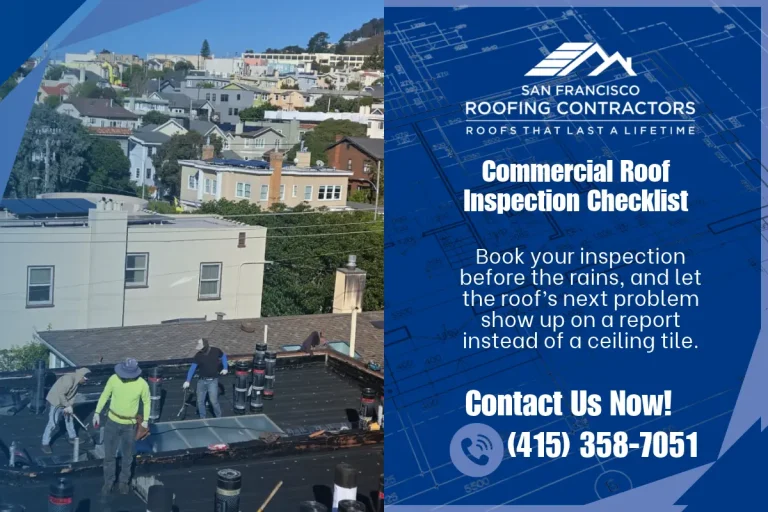
If your roof hasn’t had a full walk-through since last winter, the window before the rains is closing. San Francisco Roofing Contractors will work through a complete commercial roof inspection checklist on your building, mark every finding on a roof plan, and tell you plainly what can wait. Book your inspection before the rains, and let the roof’s next problem show up on a report instead of a ceiling tile.