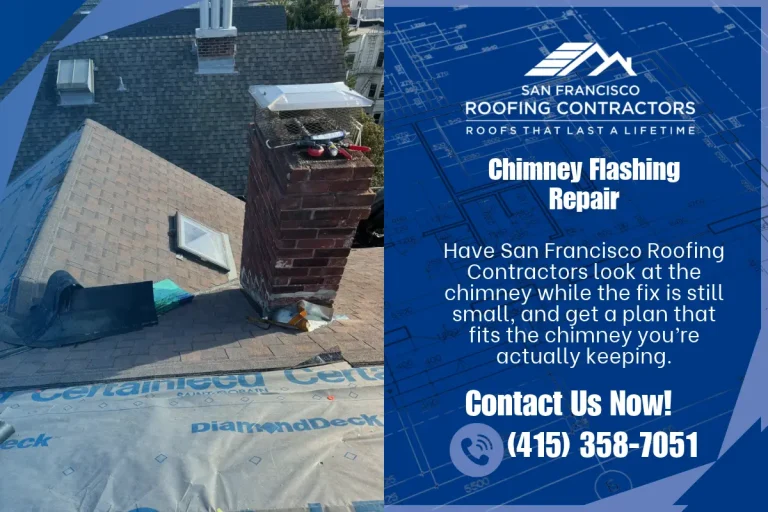

Run a hand along the counterflashing on an old Pacific Heights chimney, and it often slides out of the mortar joint like a bookmark. The metal is fine. The mortar holding it gave up years ago.
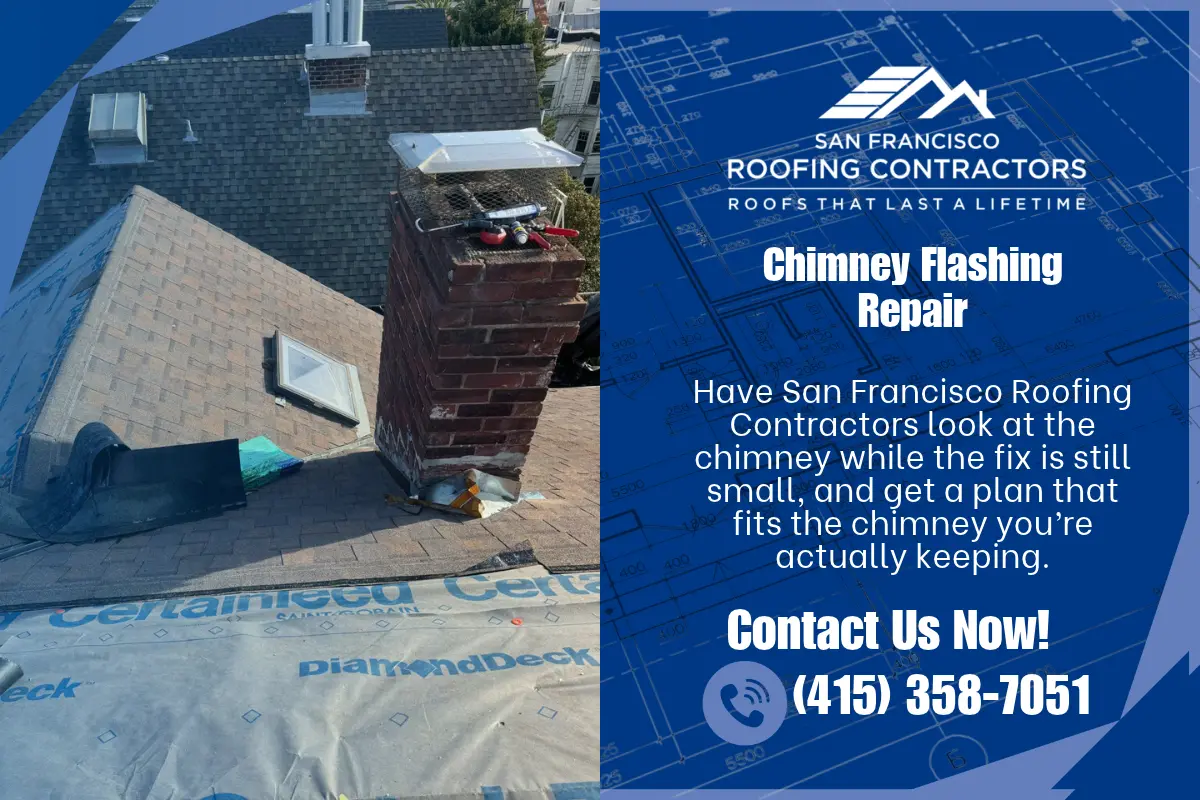
Chimney flashing repair is the work of resealing the joint where a chimney passes through the roof. It usually involves replacing or resetting the metal pieces that shed water around the brick. Those pieces include step flashing woven into the roofing, counterflashing set into the masonry, and often a small sloped saddle behind the chimney.
That joint matters because it is one of the busiest water paths on any roof. A chimney blocks runoff, collects wind-driven rain, and moves independently from the framing around it.
San Francisco changes the answer in two ways. Older brick chimneys here sit in a seismic zone, so many have been, or will be, retrofitted, braced, or shortened. Every one of those changes rewrites the flashing.
What Are the Parts of Chimney Flashing?
Chimney flashing is a layered system, not a single strip of metal. Each part covers a different weakness.
| Component | What It Does | How It Usually Fails |
| Step flashing | L-shaped pieces woven under each course of roofing along the chimney sides | Rusts through, or gets nailed wrong during a reroof |
| Counterflashing | Metal set into the mortar joints, lapping down over the step flashing | Loosens as mortar erodes; gets “fixed” with caulk |
| Front apron | One piece sealing the downhill face of the chimney | Lifts at the corners where wind gets under it |
| Cricket (saddle) | A small peaked roof behind the chimney that splits runoff | Missing, undersized, or flashed into a dead valley |
| Chimney cap and crown | Concrete or metal top that keeps water out of the masonry | Cracks let water into the brick from above |
The crown is worth noting. Some “flashing leaks” actually start at the top of the chimney, run down through the brick, and exit at the roofline.
Why Does Chimney Flashing Fail on San Francisco Homes?
Mortar That No Longer Holds the Metal
Counterflashing is only as secure as the mortar joint it sits in. Fog and salt air keep older lime mortar damp, and damp mortar slowly softens and erodes. Once the joint opens, the counterflashing hangs loose and water slips behind it.
Brick and Roof Move Differently
A chimney is heavy masonry. The roof around it is light wood framing. During small earthquakes, and even seasonal swelling, the two shift independently. Flashing nailed rigidly to both tends to tear at the corners first.
Missing or Undersized Crickets
Wide chimneys trap water on their uphill side. Under the California Residential Code §R1003.20, a cricket is required behind a chimney wider than 30 inches parallel to the ridge that doesn’t meet the ridge, with its height set by roof slope. Many older San Francisco chimneys predate that rule and never got one.
Flashing Hidden Behind Ornamental Woodwork
In San Francisco’s Pacific Heights and Presidio Heights, Victorian and Edwardian chimneys often rise beside decorative cornices and parapets. The flashing transitions disappear behind trim, so leaks get blamed on siding or windows. Water follows patience, and it can travel along a hidden ledge for weeks before showing on a plaster wall.
Years of Tar and Caulk
Roofing cement smeared over old flashing is the most common patch we see. It seals for a season, then cracks and holds water against the metal it was meant to protect.
How Do Seismic Retrofits Change Chimney Flashing Repair?
San Francisco’s own Earthquake Safety Implementation Program studied this housing stock. It found that masonry chimneys on the city’s Victorian rowhouses and setback houses are mostly unreinforced, and most are vulnerable to partial or total collapse.
That makes retrofits common, and each option changes what happens at the roofline.
| Retrofit Approach | What Changes on the Roof | What It Means for Flashing |
| Remove the chimney to the roofline and cap it | The penetration may disappear entirely | Roof deck patched and reroofed in that area; no chimney flashing left |
| Replace with a light-frame chase and metal flue | A wood-framed box replaces the brick | New step flashing and counterflashing sized to the new chase |
| Rebuild in reinforced masonry | New brick and new mortar joints | Fresh counterflashing reglets and a properly sized cricket |
| Brace the existing chimney | Bracing hardware connects chimney and roof | Every brace attachment becomes a new roof penetration |
Bracing deserves a caution. FEMA’s South Napa recovery advisory recommends against retrofitting masonry chimneys with steel braces that extend down to the roof surface. From a roofing view, those braces also puncture the roof in places nobody inspects.
The practical point: coordinate the retrofit and the roofing together. Flashing installed before a seismic contractor works on the chimney usually gets disturbed. Flashing installed after should match the chimney that will actually stay.
Is It the Flashing or the Chimney? A Leak Diagnosis Checklist
Good chimney leak repair starts by separating flashing problems from masonry problems. They look identical from inside the house.
Signs that point to the flashing:
- Stains on the ceiling or wall directly beside the chimney
- Leaks during wind-driven storms but not gentle rain
- Counterflashing you can lift by hand
- Caulk or tar smeared along the roof-to-brick joint
Signs that point to the masonry:
- Damp brick inside the attic well above the roofline
- White mineral streaks (efflorescence) on the chimney exterior
- A cracked crown or missing chimney cap
- Leaks that continue for a day or two after rain stops
How a careful diagnosis usually goes:
- Inspect the crown and cap first, from the top down
- Check counterflashing for loose joints and caulk patches
- Lift roofing at the sides to see the step flashing
- Look behind the chimney for standing water or debris
- Water-test one side at a time, starting low and working up
Repair, Reflash, or Rethink the Chimney?
Not every chimney leak needs a full reflash. Here is how we usually think through it.
| What We Find | Likely Answer |
| One loose section of counterflashing, mortar mostly sound | Reset and repoint that section |
| Rusted step flashing or caulk-patched joints all around | Full reflash, often during a reroof |
| No cricket behind a wide chimney | Add a cricket as part of the repair |
| Crumbling mortar and a retrofit being considered | Pause flashing work until the chimney plan is settled |
| Chimney no longer used | Discuss removal to the roofline with an engineer |
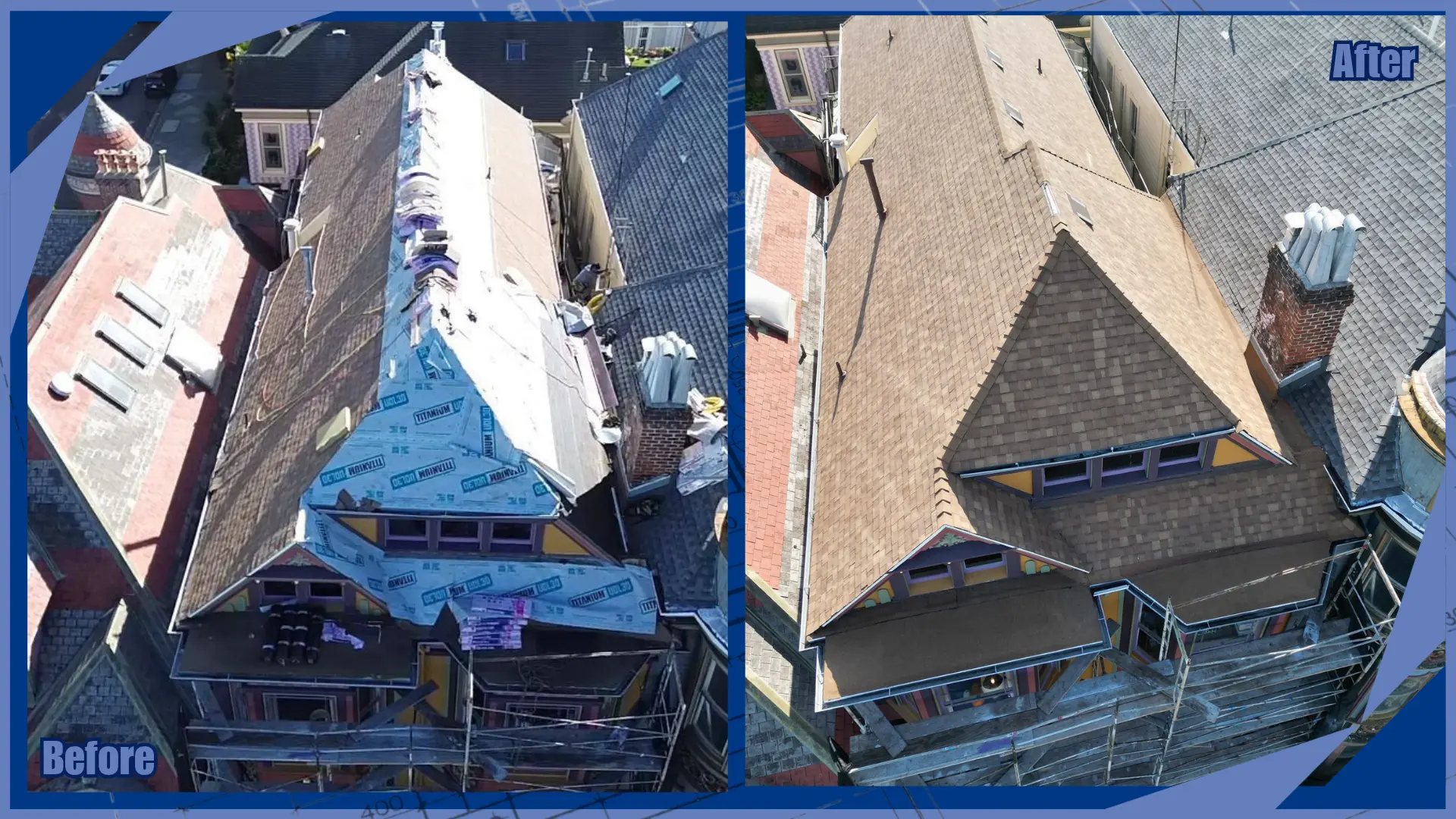
Chimney flashing repair done alongside a reroof is usually the cleanest route, since the step flashing lives under the roofing anyway. For homes with sound roofs, targeted roof flashing repair at the chimney alone can be the honest answer.
Frequently Asked Questions
How long does chimney flashing last?
It depends on the metal and how it was installed. Copper and properly coated steel outlast cheap galvanized pieces.
In practice, the mortar often fails before the metal does. That’s why counterflashing work usually includes repointing.
Can I just seal around my chimney with caulk?
It may stop a drip for a few months. It won’t fix flashing that has pulled away or rusted through. Caulk also hides the real condition from the next person who inspects it. Use it as a temporary measure only.
Why does my chimney only leak during certain storms?
Usually because of wind direction. A storm from one side drives rain under a loose apron or behind lifted counterflashing. Note which storms cause the leak. That detail narrows the diagnosis quickly.
Do I need a permit for chimney work in San Francisco?
Simple flashing repair often doesn’t require one. Seismic retrofits, rebuilds, and removals typically do. Requirements vary by scope, so check with the Department of Building Inspection before structural work begins.
Should I retrofit my chimney before replacing my roof?
Ideally, yes, or at least at the same time. Retrofit work disturbs the flashing and roofing around the chimney. Sequencing them together avoids paying to flash the same chimney twice.
Is a leaking chimney a sign it’s structurally unsafe?
Not necessarily. Most leaks come from flashing or the crown, not structural failure. But water in old brick does weaken mortar over time. A leak is a good reason to have the masonry looked at too.
What We’d Actually Tell a Neighbor
Your chimney is two problems in one: a water joint and an old piece of masonry. Fix the water without considering the brick, and you may be paying for flashing again after a retrofit.
If you’ve seen a stain beside the chimney, loose metal along the brick, or a fresh smear of tar from a past patch, don’t wait for the next storm to settle it. A chimney flashing repair now is a modest job compared with a soaked ceiling, wet framing, and rework later. Have San Francisco Roofing Contractors look at the chimney while the fix is still small, and get a plan that fits the chimney you’re actually keeping.