
Walk a flat roof in San Francisco and the membrane rarely tells the whole story. The seams, drains, penetrations, attachment method, and surrounding equipment often matter just as much.
When comparing TPO vs PVC roofing in San Francisco, neither membrane is automatically right for every building. TPO can offer a practical balance of weather resistance, flexibility, reflectivity, and cost. PVC brings similar low-slope performance while offering stronger chemical resistance for certain environments.
San Francisco changes the conversation because commercial roofs face persistent moisture, coastal exposure, wind, and complicated rooftop layouts. The right choice depends on how the building is used and how the roof will be maintained.
What Are TPO And PVC Roofing Membranes?
TPO and PVC are both single-ply thermoplastic roofing membranes used primarily on low-slope and flat roofs. They arrive in large sheets, which are typically mechanically attached or adhered to the roof assembly. Their seams are heat-welded, creating a continuous waterproof surface when properly installed.
TPO stands for thermoplastic polyolefin. It is known for flexibility, UV resistance, weather resistance, and reflective surfaces. PVC, or polyvinyl chloride, also offers UV and weather resistance but has a notable advantage when roofs face certain chemicals, oils, or grease.
The important point is that neither membrane exists independently. Insulation, drainage, flashing, penetrations, and the roof deck all influence performance.
TPO Vs PVC Roofing In San Francisco: How Should You Compare Them?
A useful comparison starts with the building rather than the product brochure. Consider what sits on the roof, what reaches the membrane, and how water leaves the surface.
| Consideration | TPO | PVC |
| Weather and UV exposure | Strong performance | Strong performance |
| Heat-welded seams | Yes | Yes |
| Chemical resistance | Good, depending on exposure | Generally stronger for certain chemicals |
| Typical applications | Commercial and low-slope roofs | Commercial, industrial, and specialty applications |
| Cost positioning | Often more cost-conscious | Often carries a higher material cost |
| Best fit | Buildings seeking balanced performance | Buildings with greater chemical exposure concerns |
These differences are not absolute. Membrane formulation, thickness, reinforcement, installation quality, and the complete roofing assembly all affect results.
Where TPO Can Make Sense
TPO can be a sensible option when the building needs a durable low-slope membrane without unusual chemical exposure.
Its reflective surface can also help reduce solar heat gain, depending on the membrane color and assembly. Manufacturers commonly specify TPO for commercial roofs where flexibility, weldability, UV resistance, and weather performance are important.
For a mixed-use building in SoMA, for example, the membrane itself may not be the hardest part of the job. Rooftop HVAC units, vents, drains, and service pathways can create numerous detailing points.
Where PVC Can Make More Sense
PVC becomes more interesting when the roof faces oils, grease, or other chemical exposure.
Johns Manville describes PVC systems as inherently resistant to oils, air-conditioning coolants, fuels, and grease. GAF similarly identifies PVC as a strong choice for roofs exposed to certain harsh chemical elements.
That can matter for particular commercial buildings, restaurants, industrial facilities, or roofs with equipment that creates chemical exposure.
PVC is not simply a more durable version of TPO, however. The material choice should match the actual conditions rather than assumptions about which membrane is universally superior.
What Matters More Than The Membrane Choice?
A membrane can be well suited to the building and still perform poorly if the surrounding details are wrong.
Drainage is one example. A low-slope roof needs a reliable path for water to reach drains or other approved drainage points. A San Francisco project document, for example, specifies positive slope toward drains for a TPO roof assembly.
The same principle applies to penetrations. In SoMA and the Financial District, commercial roofs often carry HVAC equipment and other rooftop systems. Every curb, vent, pipe, and service penetration creates another transition that needs careful detailing.
Details decide durability.
This is also where installation quality matters. Heat-welded seams need proper preparation and welding. Flashing needs to be integrated correctly. The attachment method needs to suit the deck, insulation, wind exposure, and overall assembly.
How San Francisco’s Coastal Conditions Affect The Decision
San Francisco’s coastal environment does not automatically favor one membrane. Instead, it makes the complete roof design more important.
In Marina and Cow Hollow, bay exposure can accelerate corrosion of metal components and fasteners. On buildings around Potrero Hill and Dogpatch, mixed residential and light-industrial roofs may combine membrane areas with rooftop equipment and other penetrations.
Near the Sunset District and Outer Richmond, moisture can linger around low-slope roof areas. Ponding after fog or drainage obstructions deserves attention even when there has been little rain.
That is why asking for the best flat roof membrane for coastal climate is only the beginning. The better question is how the entire roof assembly will handle moisture, drainage, wind, equipment, and maintenance.
What About TPO Roofing Cost?
Material cost is only one part of a roofing budget. The TPO roofing cost for a particular project can change with membrane thickness, insulation, attachment method, roof access, tear-off requirements, deck repairs, and detailing.
PVC can also have different upfront pricing depending on the product and assembly specified. Comparing membrane prices without comparing the complete scope can make two estimates appear more different than they actually are.
Look at what each proposal includes. A cheaper membrane does not necessarily produce a cheaper roof when the assembly, preparation, or detailing differs.
A Practical Way To Choose Between TPO And PVC
Start with the building’s actual conditions.
Choose based on exposure. Identify whether the roof encounters grease, oils, chemicals, heavy equipment traffic, or unusual contaminants.
Look at the roof assembly. Consider insulation, deck condition, slope, drains, attachment, and flashing rather than focusing only on membrane type.
Review rooftop equipment. HVAC curbs and penetrations deserve particular attention because they create concentrated detailing points.
Compare complete proposals. A useful single ply membrane comparison should examine materials, preparation, installation, warranty terms, drainage work, and expected maintenance.
Think beyond installation day. The membrane should fit the building’s long-term use and maintenance plan.
Frequently Asked Questions
Is TPO Or PVC Better For San Francisco?
Neither is universally better. TPO can provide strong weather and UV performance, while PVC may make more sense where chemical exposure is a concern.
The building’s use, roof assembly, drainage, equipment, and exposure should guide the decision.
Does Coastal Air Damage TPO Or PVC?
Coastal conditions can affect roofing systems, but the membrane is only one component. Metal fasteners, flashing, equipment supports, and other components may experience corrosion in exposed locations.
Regular inspection helps identify deterioration before it affects the waterproofing system.
Are TPO And PVC Suitable For Flat Roofs?
Yes. Both are widely used for low-slope commercial roofing systems. Their large sheets and heat-welded seams make them useful for creating continuous waterproofing across broad roof areas.
The roof still needs appropriate slope and drainage. A membrane cannot compensate for persistent ponding caused by poor design or blocked drainage.
Which Membrane Has Lower Maintenance Needs?
Neither should be chosen solely because it appears easier to maintain. Maintenance depends heavily on roof access, equipment, drainage, penetrations, and the quality of installation.
Regular inspections can catch seam, flashing, drainage, and penetration issues before they become larger problems.
What Should A San Francisco Building Owner Ask A Roofer?
Ask why the membrane suits the building specifically. Then ask about drainage, insulation, deck condition, penetrations, attachment, warranty requirements, and expected maintenance.
Those answers tell you much more than a membrane name alone.
The Right Membrane Starts With The Right Questions
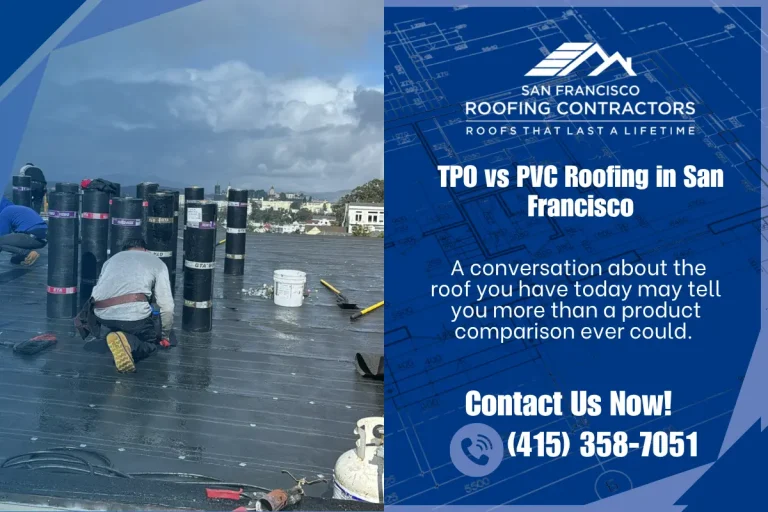
What happens after fog settles on the roof? Where does water go when the drains are working hard? What sits around the penetrations, and what happens when those details begin to age? San Francisco Roofing Contractors can help you work through those questions before settling on TPO, PVC, or another roofing approach. A conversation about the roof you have today may tell you more than a product comparison ever could.