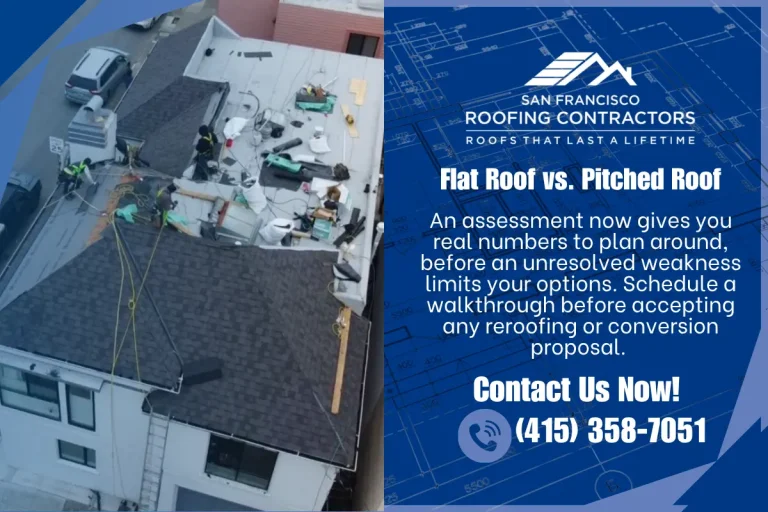

For most San Francisco homeowners, the more cost-effective choice is usually the roof form the house already has. In a flat roof vs. pitched roof decision, changing the structure rarely produces enough long-term savings to offset redesign, framing, permitting, drainage, and exterior restoration costs.
Over 20–30 years, keeping the home’s existing roof form is usually the more economical path. Converting from flat to pitched, or pitched to flat, tends to make financial sense only when structural work, recurring drainage failures, or a major renovation already require a redesign.
That doesn’t mean every roof should stay unchanged. A poorly designed drainage system, repeated transition leaks, or a major addition may justify reconsidering the roof entirely. San Francisco complicates the math further. Fog, wind, hillside exposure, and salt air all shape how each roof type performs.
The better question isn’t which roof costs less today. It’s which system fits the building and stays manageable for decades.
What’s the Actual Difference?
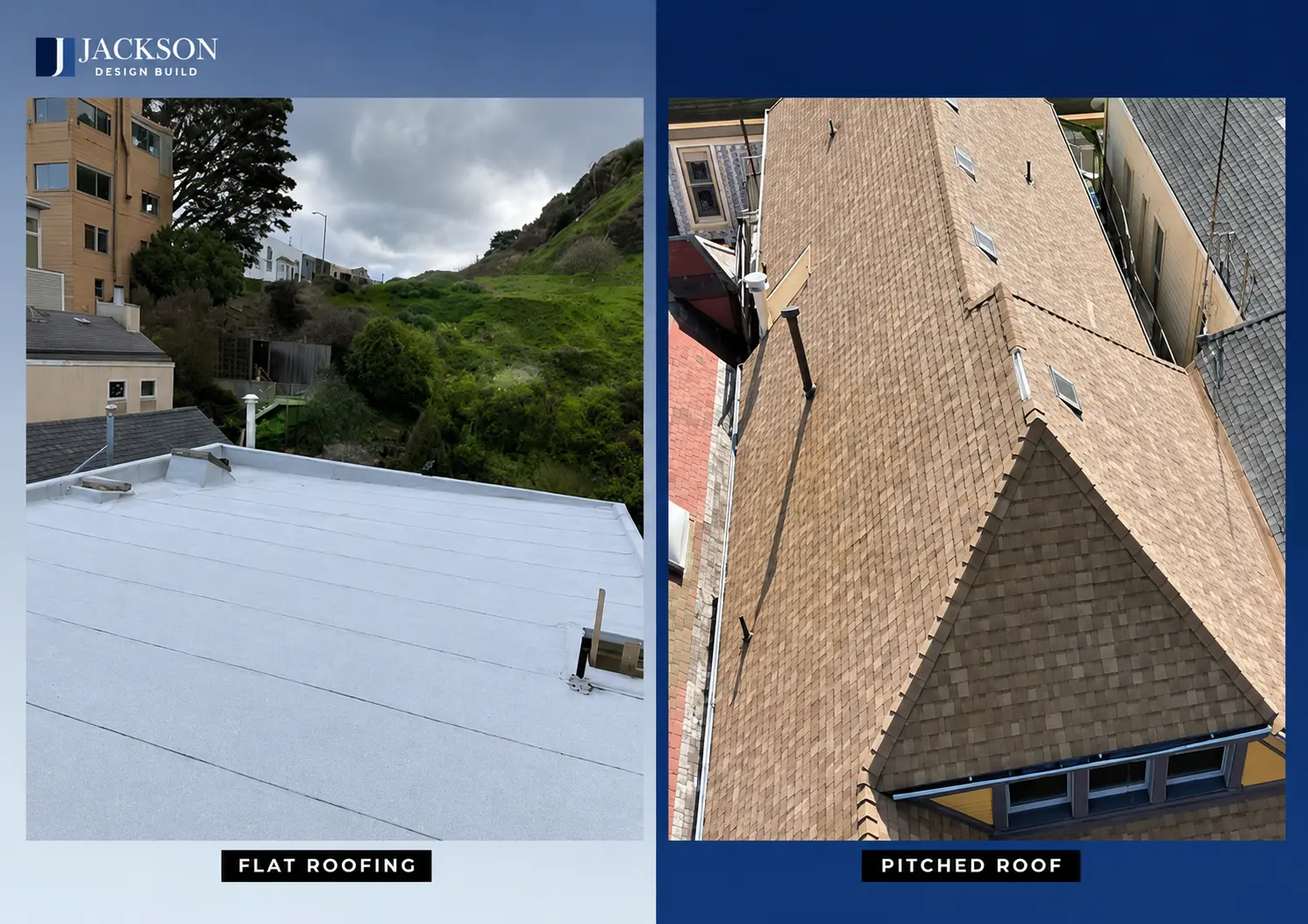
A flat roof isn’t perfectly level. It carries a slight slope toward drains, scuppers, or gutters, usually under a continuous membrane, because water moves across it more slowly.
A pitched roof sheds water toward the edges using shingles, tile, slate, or metal. Gravity does more of the work.
Both can provide decades of quiet protection. Success depends less on the shape and more on design, installation quality, drainage, and ongoing maintenance. Water follows patience. On a flat roof, it simply has more time to find a weakness before it drains away.
The 20–30 Year Comparison
Installation price does not tell the full story of what a roof will cost to own. A fair comparison has to look at what typically happens over the roof’s working life, not just what it costs to put on.
| Factor | Flat roof | Pitched roof |
| Installation | Often simpler on an existing flat structure | Straightforward when the framing is already pitched |
| Drainage | Depends on slope, drains, and clear water paths | Sheds water faster but still needs sound valleys and gutters |
| Recurring maintenance | Seams, penetrations, and drain clearing need regular attention | Flashing, valleys, and edges need periodic inspection |
| Access for inspection | Often easier to walk and inspect | Steep surfaces may require added access and safety planning |
| Conversion to the other type | Adds framing and structural complexity | Also affects structure, load paths, and drainage |
| Architectural fit | Common on row houses and modern additions | Often integral to Victorian, Edwardian, and older forms |
No contractor can hand you an exact maintenance calendar based on roof shape alone. Material, quality, and exposure all move the timeline. But the pattern tends to hold across a 20–30 year window:
Early years. Either roof typically needs little beyond routine inspection, drains, seams, and parapets on a flat roof; valleys, flashing, and gutters on a pitched one.
Middle years. Localized repairs surface as exposed components age. Flat membranes should be checked for wear or recurring ponding; pitched roofs tend to develop loose materials or aging flashing before the rest of the roof needs attention.
Later years. One roof may need full replacement while the other still only needs targeted repair, shape alone doesn’t decide which outcome you get. What decides it is whether small weaknesses got caught before moisture reached the framing underneath.
Homeowners researching flat roofing cost in San Francisco should ask what’s included beyond the membrane itself. Tapered insulation, parapet flashing, and deck condition change the number substantially. The same applies to pitched roof replacement cost in San Francisco, where steep-access requirements and material matching on older homes often account for more of the estimate than the shingles or tiles themselves.
What We See in San Francisco Specifically
Morning fog off the coast keeps roof surfaces damp well into the afternoon in low-lying corridors like the Sunset and Outer Richmond, rewarding flat roofs with clean drainage and punishing ones with sluggish drains or debris buildup.
Wind-driven rain on exposed, higher-elevation blocks near Twin Peaks and Diamond Heights tests flashing at every transition, regardless of roof shape, while salt air near the coast, Sea Cliff, the Presidio, accelerates corrosion on exposed metal flashing over time.
On a recent inspection of a flat-roofed building near the Mission, our team found a drain that had been slowly restricting flow for years, not from damage, but from debris packed against a scupper that was never checked during routine maintenance. The membrane itself was in good condition. The lesson holds across the city: many flat-roof problems develop around transitions and drains rather than across the open field of the roof.
Permits, Historic Status, and Drainage Rules
Reroofing requires a permit through the Department of Building Inspection, and structural changes like converting roof types typically follow a more detailed review path.
Buildings constructed more than 50 years ago that possess architectural or historical significance may be considered potential historic resources. Check your property’s historic resource status before planning a roof-form change.
Drainage isn’t just a design preference, either. San Francisco’s plumbing code sets requirements for how roof runoff must be conveyed, covered in the current San Francisco building codes.
What Should Be Evaluated Before You Decide
The most important distinction in any assessment is whether the roof form is failing, or whether one component is failing inside a roof that’s otherwise fine. A blocked drain doesn’t justify rebuilding a flat roof as pitched, and aging chimney flashing doesn’t mean a pitched roof is finished. Treating the wrong problem creates cost without fixing the actual issue.
Before changing roof types, it helps to ask:
- Is the roof form causing the problem, or is one detail failing?
- Can drainage improve without structural reconstruction?
- Does the home carry historic or architecturally significant features?
- Will new framing affect usable space, windows, or neighboring buildings?
- How accessible are the drains, gutters, and transitions for ongoing maintenance?
- How long do you expect to own the property?
For most homes, the smartest flat roof vs. pitched roof choice respects the architecture already in place while correcting the specific weaknesses causing trouble. Stewardship over shortcuts tends to save more than a dramatic redesign.
Frequently Asked Questions
Is a flat roof always cheaper to replace?
Not necessarily. A membrane replacement may cost less than rebuilding a pitched roof, but damaged decking, poor slope, or failing drains can add significant work either way.
Does a pitched roof last longer than a flat roof?
Not automatically. Material choice, installation quality, ventilation, and exposure influence lifespan far more than shape does.
Are flat roofs a bad choice near the coast?
No, but salt air, fog retention, and wind deserve real consideration in the fasteners, flashing, and drainage details.
Can I add a pitched roof over an existing flat roof?
Sometimes, but only after a structural evaluation. New framing changes loads and can affect parapets and drainage. This is a structural alteration, not a routine reroof.
Which roof type is better for solar panels?
Either can work well when the structure, orientation, and attachment method suit the site. Coordinate the roofing and solar plans together, since removing panels later to fix an aging roof adds avoidable cost.
Choose the Roof That Fits the Building
A roof should be judged by how it performs across decades, not by which proposal looks cheapest today. Before settling a flat roof vs. pitched roof decision, have the structure, drainage, transitions, and preservation requirements evaluated together.
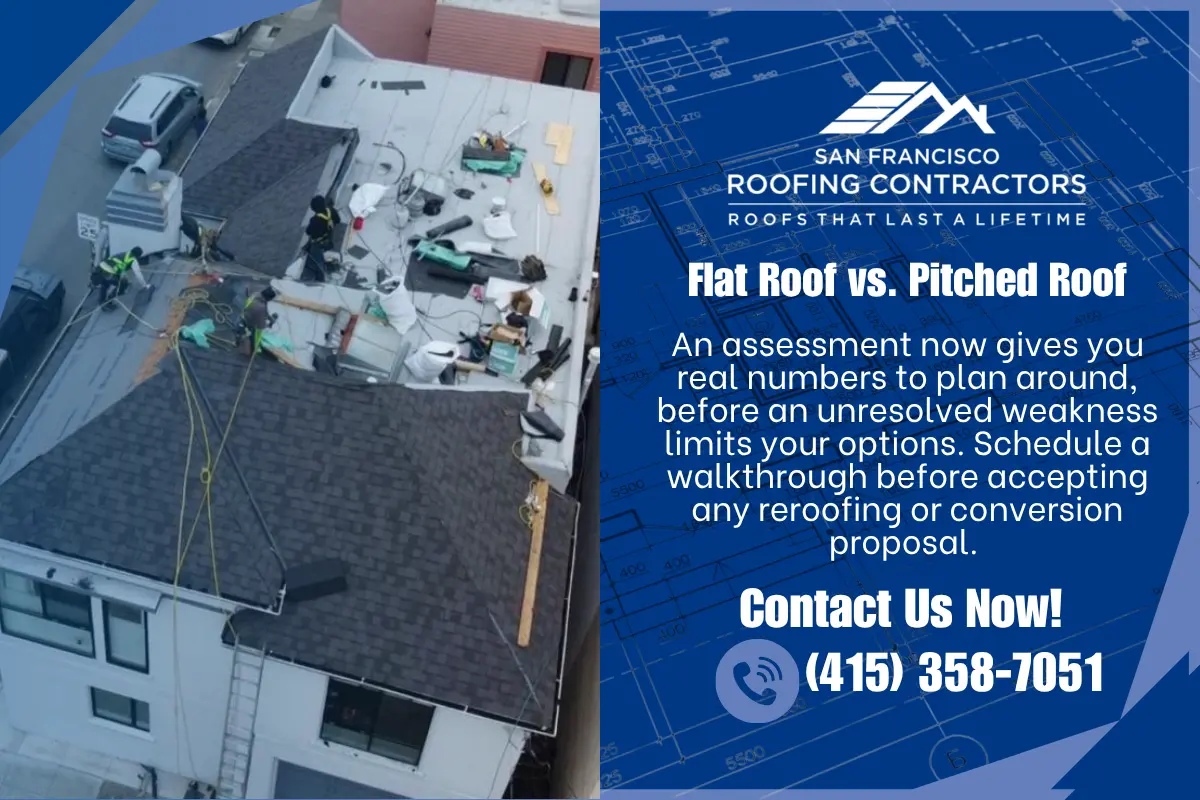
San Francisco Roofing Contractors can inspect your system and tell you plainly whether repair, replacement, or a roof-form change actually serves the home. An assessment now gives you real numbers to plan around, before an unresolved weakness limits your options. Schedule a walkthrough before accepting any reroofing or conversion proposal.